
Cornelius Previous Residents by Era
A backward household search should begin with the era, not with a name alone. Mecklenburg’s current parcel record identifies the land as it is administered now. Recorded deed systems establish transfers. Wider Charlotte and Mecklenburg directories can provide an address-to-occupant lead, while federal census, probate, wills, newspapers, and cemetery records fill different gaps. None of those sources is a complete household roll. Read them together, preserve the source date, and avoid treating a recorded owner as proof that the person lived in the home.
| Source | Years it covers | Where held | What it shows |
|---|---|---|---|
| Mecklenburg historic ROD | 1763–February 1990 | Historical portal and Register of Deeds office | Grantor, grantee, deeds, maps, images, legal descriptions |
| Mecklenburg modern ROD | March 1990–present | Web Access portal and Register of Deeds office | Recorded instruments, transfers, liens, and images |
| POLARIS and GIS | Current administrative record | Mecklenburg County GIS | Owner, situs, mailing address, parcel, legal description, map layers |
| Charlotte and Mecklenburg directories | Identified volumes from 1875/76 through 1940; later physical runs documented to 2005 | Carolina Room, DigitalNC, partner collections | Address occupant or business, names, spouse wording, and address |
| Federal census | Individual schedules through 1950 | Library, archive, and genealogy channels | Household, age, birthplace, residence, and enumeration context |
| Building records | Online documents for the latest six years; older retention varies | Mecklenburg Code Enforcement | Permit, occupancy, project date, contractor, and address evidence |
Start with a current property description when the address is known. Start with a library directory or census when the question is about a household rather than title. The Robinson-Spangler Carolina Room is the local-history fallback for directories, maps, newspapers, yearbooks, and related material. Its reference staff can identify available formats and appointment needs.
Cornelius Previous Residents in Parcel Records
Use Mecklenburg POLARIS to anchor the property before tracing past residents. Its main search accepts an address, parcel number, owner, or landmark. The card and map can provide the owner of record, parcel identifier, situs address, mailing address, legal description, sale information when populated, and linked deed references. The situs is the physical Cornelius parcel. The mailing address is where the county sends tax bills. They may not be the same place.
Save the parcel ID and legal description exactly. They protect against a common error: attaching a deed for a similar street name to the wrong lot. Recent transactions can reach the Register of Deeds before GIS data catches up, so compare the recorded date and reference when timing matters. The Land Records Management page explains the situs, mailing, and legal-description distinctions and is the correction route when county property data needs supporting deed evidence.
POLARIS identifies an ownership or tax relationship, not everyone in a household. A trust, estate, company, or distant mailing address can appear on a parcel. That is why the backward trail needs directory and census layers later in the search.
Cornelius Previous Residents Across ROD Cutoffs
Mecklenburg has a useful records split for a backward address search. ROD Web Access covers modern indexed land records from March 1990 to the present. The separate historical ROD system reaches from 1763 through February 1990 and includes index books and PDF images for deeds, old deed books, maps and plats, condo books, and satisfactions. The historical system is not just a summary of old records. It can lead to the underlying book image when an entry is located.
For a late-period historical search, use the Land type, choose Grantor or Grantee, set a year range, choose Human or Corporation, and search a surname portion. Do not rely on a street-address search for early documents. Older deeds can refer to a farm, creek, road, lot and block, acreage, or metes-and-bounds description. A legal description and the names on adjoining land are often the better bridge between a current Cornelius address and an older instrument.
Online indexes are convenience access points. The Register of Deeds real-estate records page identifies the coverage split and the office as the source for official inspection and copies. When a portal search fails, use the office, ask for the relevant book or document reference, and verify the image rather than assuming the record does not exist.
Note: The historical search instructions favor a surname portion, so trying a full first name can miss a late-period index result.
Cornelius Previous Residents and Deed Chain
Follow the deed chain backward from today’s parcel. A purchase deed normally identifies a seller, also called the grantor, and may cite the deed where that seller acquired the land. Search the seller as a prior grantee, then repeat the process while checking the legal description, lot and block, subdivision, acreage, and nearby owners. When a transfer involves an estate, trust, company, or married couple, search the entity and each applicable name form. Both grantor and grantee sides matter when the transfer is within a family or estate.
- Find the current parcel in POLARIS and record the owner, parcel ID, legal description, and any deed reference.
- Search the current owner or recorded date in the modern Register of Deeds index and open the deed image.
- Identify the seller or grantor, then search that party as a grantee before the current transfer.
- Repeat the comparison of legal description and lot information at every transfer, rather than relying on a matching surname.
- At the February and March 1990 divide, continue in the historical ROD system and use book and image references.
- Use plats, maps, satisfactions, powers of attorney, deeds of trust, and related instruments when the description or names change.
- Grantor and grantee
- The grantor transfers an interest in land. The grantee receives that recorded interest.
- Chain of title
- The dated sequence of recorded transfers tied to the same parcel or legal description.
- Legal description
- The recorded land description, such as a lot, plat, boundary description, or acreage reference. It is more stable than a changing street address.
A deed chain establishes recorded property events, not a complete occupant history. It is the framework that keeps a former-household search attached to the right Cornelius land.
Cornelius Addresses Before Lake Growth
Address continuity is a real trap in Cornelius. The county’s Address Management data can carry house number, street name, ZIP, postal city, jurisdiction, fire districts, ETJ, special tax districts, and road centerlines, but no precise Cornelius street-renumbering or renaming year was located in the research. A zero address result is not proof that no earlier household existed. Search street aliases, subdivision or lot and block, nearby churches, mills, roads, and the legal description.
Cornelius began as Liverpool and was renamed for J. B. Cornelius. Lake Norman was created in 1963, followed by subdivision and waterfront development. A present lakeside address may sit on a pre-lake farm parcel or a later plat. Separate the old parcel trail from the later street and lot configuration. That history explains why earlier deeds may describe land without the road name a resident uses today.
Historic landmark files can offer a useful second check for a known building. The county’s Cornelius Historic Landmarks page includes places such as Fidler House, Mt. Zion Parsonage, Potts Barber Shop, Smithville Rosenwald School, and the Cornelius High School Agriculture Building. A designation file can identify building chronology or prior owners, but it does not substitute for the recorded deed chain.
Cornelius Previous Residents Through Directories
Directories and census records help answer the household part of a backward address search. In a Carolina Room Charlotte or Mecklenburg volume, start with the street section for the known address. Record the principal occupant or business, symbols, and street spelling. Then use the alphabetical section for spouse or widow wording, occupation, and alternate address. The identified local runs include 1875/76, 1903, 1905/06, 1907, 1909–1918, 1920, 1931–1935, 1938, and 1940. Cornelius may be embedded in the broader volume rather than printed as a town-only section.
Pair the closest directory year with the federal census, noting the original township, rural route, enumeration district, and street form. Individual schedules are available through 1950 under the 72-year release rule. A census can include people not named in a deed. A directory can capture a principal occupant who was not the owner. Differences may reflect compilation date, initials, household definitions, municipal boundaries, or a missed listing, so they should be recorded as differences rather than forced into one answer.
- Copy the address from a dated directory street section without modernizing its spelling.
- Read the matching alphabetical entry and save spouse or widow wording, symbols, and alternate address.
- Check the available directory year before and after the entry for an arrival, move, or changed name form.
- Compare the nearest census household, keeping its printed township or rural route.
- Test a disappearance against an obituary, probate file, cemetery record, newspaper, or later deed.
The collections themselves are described in the Cornelius city directory page. That page is the place to identify a volume’s publisher, shelf, access path, and entry symbols before using it for house history.
Cornelius Previous Residents on Maps
Maps and permits can date a structure or explain a changed street context. Sanborn fire-insurance maps are especially useful for historic cores, mills, and commercial blocks. A standalone Cornelius Sanborn edition was not located in the reviewed Library of Congress result. Search the Library of Congress Sanborn guide by North Carolina and city or edition, then check Carolina Room map holdings. A map can show building footprint, use, material, and street layout. It does not name the people who lived there.
The Library of Congress Sanborn search guidance is shown in this Cornelius house-history image.
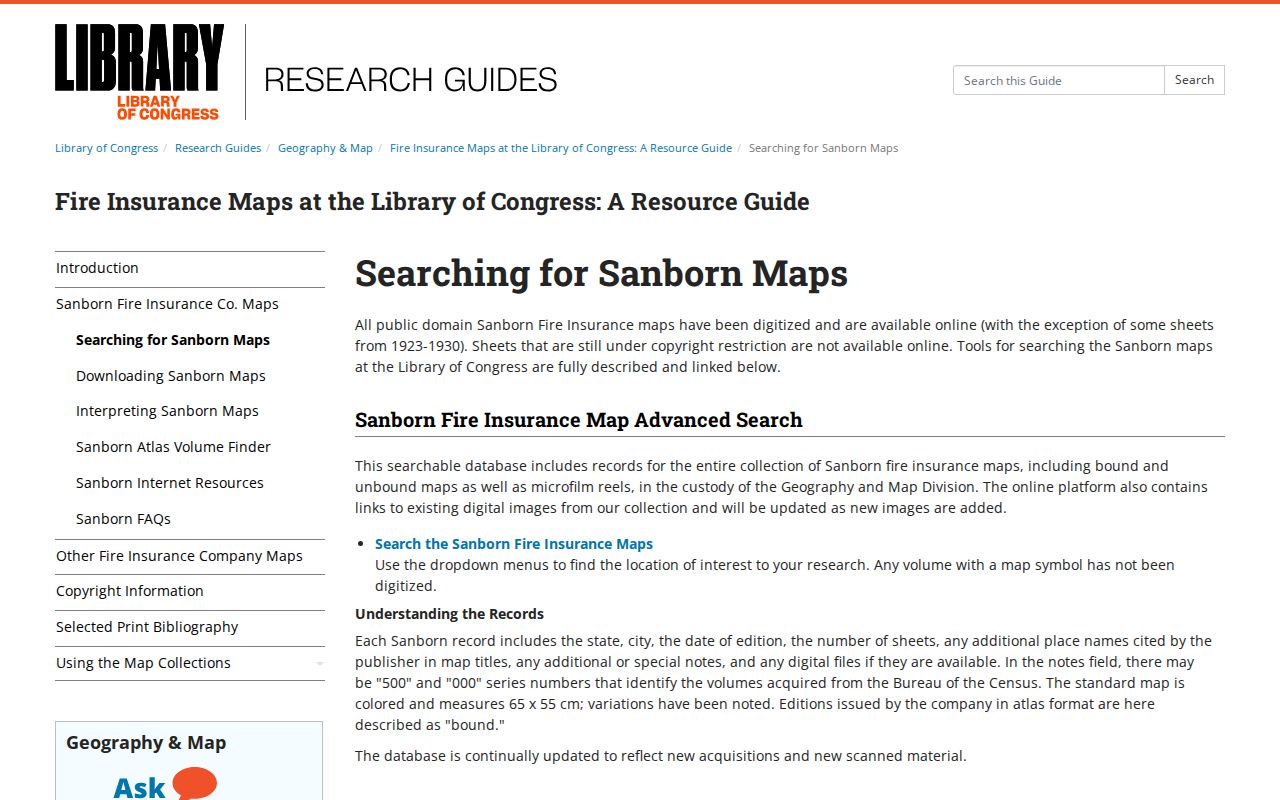
The map route can confirm the built setting around an address before a directory, deed, or census lead is interpreted.
For newer work, Mecklenburg Code Enforcement online document research retains certificates of occupancy, compliance records, and permit applications for six years. Older records and drawings use different request routes. A permit provides construction or project evidence, not a list of former household members.
Cornelius Previous Residents and Trail Endpoints
When a household disappears from the available directories, probate, wills, obituaries, and cemetery records can provide a next record location. FamilySearch estate files can contain a deceased person’s residence, heirs, property divisions, inventories, bonds, and petitions. The State Archives Mecklenburg wills index covers 1749–1967. The Charlotte Observer archive, accessible through the library, spans 1888 to the present. A probate address can be an executor or heir mailing address, so it should not be assumed to be the decedent’s final residence.
The North Carolina Public Records Act allows requests for existing public records, but it does not require an agency to compile a new history of everyone at an address. A focused request names the custodian, record type, date range, parcel, document, or case reference. The county public-records request portal is a routing option when the needed record is county-held and not already available through the office or library channel.
Lawful use. Cornelius house-history research is for family history, property context, and personal curiosity. Do not use public records to stalk, harass, or harm a living person; North Carolina law protects confidential and restricted records.
Note: Preserve the document date and source with every conclusion, because names, addresses, and the status of a record can change over time.